

The Profit Playbook: How AI Streamlines Merchandising
Your recon team just finished prepping a clean trade. Photos are done. Now it sits.
Waiting for someone to edit the images. Waiting for a description. Waiting for pricing approval. Waiting to hit your website and third-party sites. Every day that unit sits is another day of holding cost, another day closer to needing a price cut, and another day your competitor's similar unit gets the lead.
Manual merchandising is bleeding your profit per unit. The math is brutal: if your average time from acquisition to online is seven days, and your daily holding cost is $50, you're starting $350 in the hole before a single shopper even sees the listing. Multiply that across 150 units in inventory, and you're looking at serious money left on the table.
AI automotive technology changes the equation. It automates the grunt work that bogs down your merchandising workflow, cuts your time to market in half, and frees your team to do what they do best: sell cars and build relationships.
This isn't about replacing your people. It's about giving them leverage.
What follows is the operational playbook your competitors are still figuring out. We're going tactical: step-by-step implementation, pilot frameworks, and the exact workflow changes that turn AI from buzzword to profit driver.
The Real Cost of Slow Merchandising
Most dealers know slow merchandising hurts. Few have actually calculated what it costs.
Start with holding costs. Every day a unit sits on your lot, you're paying interest on floorplan, insurance, and opportunity cost. Depending on your floorplan rate and average unit value, that's $40 to $75 per day per vehicle. A seven-day merchandising process costs you $280 to $525 before the car even goes live online.
Now add time-to-market impact on selling price. Data from multiple dealer groups shows that units listed within 48 hours of acquisition sell for 2% to 4% more than units that take a week or longer to merchandise. On a $25,000 unit, that's $500 to $1,000 in gross profit. The reason is simple: fresh inventory photographs better, shows better, and hasn't been shopped by every competitor in your market yet.
Inconsistent photo quality kills conversion rates. When half your VDPs have professional-looking images and the other half look like they were shot in a dimly lit corner of your lot, shoppers notice. They assume the inconsistency reflects the quality of your operation. Third-party listing sites penalize inconsistent inventory with lower placement in search results, which means fewer eyeballs and fewer leads.
Manual description writing creates another bottleneck. Your best writer can knock out maybe 15 to 20 compelling, unique descriptions per day. That's fine if you're turning 40 units a month. It's a disaster if you're doing 150. The result is either generic copy-paste descriptions that don't sell, or a backlog that delays time to market even further.
The compounding effect is what really hurts. Slow merchandising means older inventory. Older inventory means price cuts. Price cuts mean lower gross profit and higher days supply. Higher days supply means more floorplan expense. It's a cycle that starts with a merchandising workflow that can't keep pace with acquisition.
Where AI Streamlines the Merchandising Workflow
AI automotive technology attacks the three biggest time sinks in merchandising: photo editing, description writing, and syndication compliance.
AI Photo Editing: From Raw to Retail-Ready in Minutes
Traditional photo editing is labor-intensive. Someone has to open each image, adjust lighting and color balance, crop to standard dimensions, and often manually remove distracting backgrounds or objects. An experienced editor can process 8 to 12 units per day if they're moving fast.
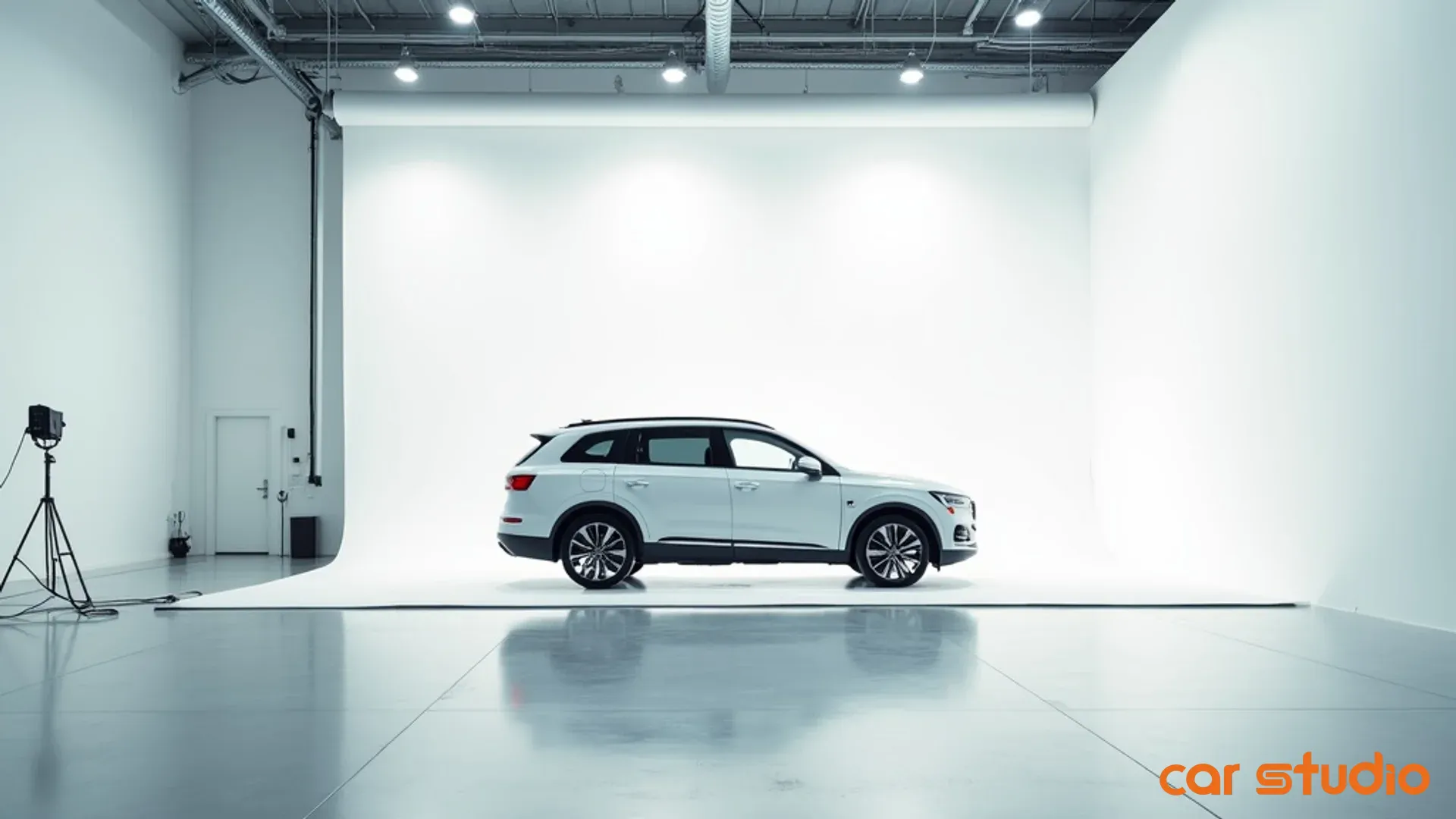
AI photo editors handle the heavy lifting automatically. Background replacement happens in seconds, turning a cluttered lot shot into a clean studio-quality image. Lighting and color correction apply consistently across every photo, eliminating the variability that makes your inventory look unprofessional.
Unblur image technology salvages photos that would otherwise need reshoots. If your photographer's hand shook or the camera focused on the wrong element, an artificial intelligence image editor can recover sharpness and detail that manual editing can't touch. That alone saves hours of reshoot time per week.
Enhancement tools bring out paint depth, wheel detail, and interior texture without the over-processed look that screams "edited." The goal isn't to misrepresent the vehicle; it's to present it the way it looks to a buyer standing on your lot in good light.
Platforms like Car Studio AI bundle these capabilities into a single workflow. Upload raw photos, apply your dealership's visual standards automatically, and export retail-ready images in the time it used to take to open Photoshop.
AI Descriptions: Unique, Compelling VDP Copy at Scale
Generic descriptions don't sell. "Nice car, runs great, won't last long" might have worked in 2005. Today's shoppers expect detailed, benefit-focused copy that tells them why this specific unit is worth their time.
AI description generators analyze vehicle data, trim details, equipment lists, and market positioning to create unique copy for every VDP. The output isn't just a list of features; it's structured storytelling that highlights what matters to buyers in your market.
Good AI tools let you set tone and style parameters. If your brand voice is professional and detail-oriented, the AI matches that. If you want a more conversational, benefit-driven approach, it adapts. The key is consistency across your entire inventory without the manual effort of writing 150 unique descriptions every month.
The time savings are significant. What takes a skilled writer 15 to 20 minutes per unit takes AI 30 seconds. That's the difference between merchandising 20 units per day and merchandising 200.
Syndication and Compliance: Automated Quality Control
Every third-party site has different image requirements, character limits, and formatting rules. Managing syndication manually means constant checking, reformatting, and fixing errors after the fact.
AI-powered syndication tools auto-check your listings against platform requirements before they go live. Image dimensions wrong for AutoTrader? Fixed. Description too long for Cars.com? Trimmed to fit without losing key selling points. Missing required fields for CarGurus? Flagged before submission.
This eliminates the back-and-forth that delays listings and the compliance errors that get your inventory suppressed or penalized in search rankings.
Consistency across platforms builds trust. When a shopper sees your unit on three different sites and the photos, price, and description match perfectly, they perceive your operation as professional and reliable. When details don't match, they assume something's wrong and move on.
The Implementation Playbook: Activating Your AI Strategy
Most dealers fail at AI adoption because they try to boil the ocean. They want to transform everything at once, get overwhelmed by options, and end up doing nothing.
The right approach is surgical: identify the highest-impact bottleneck, pilot a solution, measure results, and scale what works.
Step 1: Audit Your Current Workflow
Map your existing merchandising process from acquisition to live listing. Include every step, every handoff, and every approval gate.
Start with acquisition. When does the clock start? Is it when the trade hits your lot, when recon is complete, or when the unit is ready for photos?
Track photo workflow. Who shoots? When? How long does it take to get images off the camera and into your editing queue? Who edits? How long does editing take per unit? Where do edited photos go, and who uploads them?
Document description writing. Who writes? How long per unit? Do you have templates, or is every description custom? How do descriptions get into your CRM or inventory management system?
Identify syndication steps. Who handles third-party listings? How long after photos and descriptions are ready does it take to go live on AutoTrader, Cars.com, and your website? How often do listings get rejected or flagged for compliance issues?
Measure time at each stage. Use real data from the last 30 days, not best-case estimates. The goal is to find where time piles up and where errors happen most often.
Most dealers discover that photo editing and description writing account for 60% to 75% of total merchandising time. That's where AI delivers the fastest ROI.
Step 2: Identify Your Biggest Time Sinks
Once you've mapped the workflow, rank each stage by time consumed and frequency of errors or delays.
High time, high frequency problems are your priority targets. If photo editing takes two days per batch and happens for every unit, that's your starting point.
High time, low frequency problems can wait. If pricing approval occasionally takes an extra day but only affects 10% of units, it's not your first AI use case.
Low time, high frequency problems are good secondary targets. If syndication errors happen constantly but only take 15 minutes each to fix, an AI compliance tool delivers quick wins without massive time savings.
Low time, low frequency problems aren't worth automating yet. Focus on the big rocks first.
Step 3: Pilot With a Small Batch of Units
Choose 10 to 20 units for your pilot. Pick a mix of vehicle types and conditions so you're testing the AI tool across realistic scenarios, not just cherry-picked easy wins.
Run the pilot in parallel with your existing process. Don't shut down your manual workflow yet. Process the same units through both the AI tool and your traditional method, then compare results.
Measure three things: time savings, output quality, and error rate.
Time savings should be obvious and significant. If the AI tool only saves 20% of the time, it's probably not worth the switching cost. Look for 50% or better.
Output quality is subjective but critical. Have your team and a few trusted customers evaluate AI-edited photos and AI-generated descriptions against manually created versions. If the AI output is noticeably worse, the tool isn't ready or needs better configuration.
Error rate matters more than most dealers expect. If the AI tool is fast but creates syndication errors, missing data, or off-brand copy, you'll spend the time savings fixing mistakes.
Track costs during the pilot. Include software fees, team time for setup and training, and any integration work. Compare that to the labor cost of your manual process for the same units.
Set a decision threshold before you start. For example: "If the AI tool saves 50% of merchandising time, maintains quality scores above 8 out of 10, and costs less than our current labor expense, we'll scale it."
Step 4: Measure Impact and Scale Across Inventory
If the pilot hits your success criteria, scale in phases. Start with 25% of your inventory, then 50%, then full deployment.
Phased scaling lets you catch integration issues, train your team gradually, and adjust workflows without disrupting your entire operation.
Track the same metrics you measured in the pilot: time to market, photo and description quality, syndication error rates, and cost per unit. Add business outcome metrics: days to sale, gross profit per unit, and lead volume per VDP.
The goal isn't just faster merchandising. It's better business results. If AI cuts your time to market from seven days to three but doesn't improve turn rate or gross profit, something else in your sales process is broken.
Most dealers see measurable improvements in lead volume within 30 days of full deployment. Faster time to market and higher-quality VDPs mean more shoppers engage with your inventory. More engagement means more leads, more appointments, and more deals.
Adjust as you scale. If AI-generated descriptions need more customization for high-value units, build that into your workflow. If certain vehicle types need manual photo review, create an exception process. The goal is leverage, not rigidity.
Quick Wins in 14 Days
You don't need a six-month implementation plan to see results. Here's a focused sprint that delivers measurable improvements in two weeks.
Day 1 to 3: Automate Photo Background Replacement
Pick an AI photo editor that handles background replacement. Car Studio AI, or similar platforms, can do this in seconds per image.
Select 15 units currently in your inventory with inconsistent or distracting backgrounds. Run them through the AI tool and replace backgrounds with clean, neutral, or branded environments.
Upload the new images to your VDPs and third-party listings. Track engagement metrics: page views, time on page, and lead submissions for those 15 units compared to similar units with original photos.
Most dealers see a 15% to 30% increase in VDP engagement within 72 hours of swapping in cleaner photos. Shoppers spend more time on the page, view more photos, and submit more leads.
Day 4 to 7: Implement AI-Generated Descriptions
Choose 20 units that currently have generic or minimal descriptions. Run them through an AI description generator, review the output for accuracy and brand voice, and publish.
Compare lead volume and lead quality for these units against similar inventory with manual descriptions. Track how many leads mention specific features or benefits that the AI copy highlighted.
Good AI descriptions don't just increase lead volume; they improve lead quality. Shoppers who read detailed, benefit-focused copy are further along in the buying process and more likely to convert to appointments.
Day 8 to 14: Measure Time to Market and VDP Quality
Pull your merchandising data for the past two weeks. Calculate average time from acquisition to live listing for units that used AI tools versus units that went through your traditional process.
Survey your team. Ask how much time they saved, what friction points remain, and whether they'd want to keep using the AI tools.
Review VDP quality scores. Have your sales team and a few customers rate photo quality, description usefulness, and overall professionalism for AI-assisted VDPs versus manual ones.
Compile the results into a simple summary: time saved, quality maintained or improved, and cost per unit. Use that data to decide whether to expand AI usage across more of your inventory.
Objections and Pitfalls to Avoid
Every dealer considering AI tools has the same concerns. Let's address them directly.
"AI Will Replace My Team"
No, it won't. AI handles repetitive, time-consuming tasks that don't require human judgment. It doesn't negotiate deals, build customer relationships, or make strategic decisions about pricing and inventory mix.
What AI does is free your team from grunt work so they can focus on higher-value activities. Your photographer spends less time editing and more time shooting. Your writer spends less time on generic descriptions and more time on high-value units that need custom storytelling. Your sales team gets leads faster because merchandising doesn't bottleneck inventory flow.
Think of AI as leverage, not replacement. A single team member with AI tools can do the work of three without AI. That means you can handle more volume with the same headcount, or reallocate labor to areas that directly drive revenue.
"It's Too Expensive or Too Complex"
AI tools have come down in price dramatically. Many platforms charge per unit or per image processed, which means your cost scales with your volume. You're not buying enterprise software with six-figure upfront fees.
Complexity is also overstated. Modern AI tools are designed for non-technical users. If your team can use your CRM or inventory management system, they can use an AI photo editor or description generator.
Start small. Pilot with a single tool that solves your biggest bottleneck. If it works and delivers ROI, add more capabilities. If it doesn't, you've spent a few hundred dollars and a couple of weeks learning what doesn't fit your operation.
The bigger risk is doing nothing. Your competitors are adopting these tools. If they're merchandising inventory in three days and you're still taking seven, they're winning deals you should have closed.
Choosing the Wrong Tools or Partners
Not all AI tools are created equal. Some are built for enterprise dealer groups with dedicated IT teams. Others are designed for independent dealers who need plug-and-play simplicity.
Evaluate tools based on your operation's size and complexity. If you're a single-point dealer doing 75 units a month, you don't need the same platform as a 10-store group doing 1,500.
Look for tools that integrate with your existing systems. If the AI photo editor doesn't play nicely with your inventory management system or CRM, you'll spend more time on workarounds than you save on automation.
Test before you commit. Most AI vendors offer free trials or pilot programs. Use them. Process real inventory through the tool and measure results before signing a contract.
Ask for references from dealers similar to your operation. A tool that works great for a high-volume metro dealer might not fit a smaller rural store, and vice versa.
Avoid tools that require you to change your entire workflow to fit their process. The best AI tools adapt to how you already work, not the other way around.
The Competitive Edge You Can't Ignore
AI automotive technology isn't a nice-to-have anymore. It's table stakes.
Your competitors are cutting time to market, improving VDP quality, and reducing labor costs. If you're still merchandising manually, you're starting every deal at a disadvantage.
The good news is that implementation doesn't have to be complicated or expensive. Start with the highest-impact bottleneck in your workflow, pilot a solution, measure results, and scale what works.
Focus on tools that solve real operational problems, not buzzwords. AI photo editing, AI-generated descriptions, and automated syndication compliance deliver measurable ROI because they attack the time sinks and error-prone steps that slow down every dealer.
Your team won't resist AI if you position it correctly. Frame it as leverage that lets them do more of what they're good at and less of the tedious work that bogs them down. Show them the time savings and the quality improvements, and they'll become your biggest advocates.
The dealers who win in the next five years will be the ones who use technology to create operational leverage. More inventory turns, higher gross profit per unit, and lower labor costs per unit sold. That's the AI advantage, and it's available right now.
Ready to streamline your merchandising? See how Car Studio AI automates your photo-to-profit workflow in a personalized demo. We'll show you exactly how our platform fits your operation and what results you can expect in the first 30 days.
Stop losing profit to slow processes. Let's build your AI merchandising playbook together. Book a 20-minute consultation and we'll map your current workflow, identify your highest-impact opportunities, and show you what's possible when you give your team the right tools.